



In the Know
In the Know
In the Know
In the Know
In the Know
In the Know
Packing for Mars: The Curious Science of Life in the Void
By Mary Roach
As Reviewed by Macy Walsh
Mary Roach has an uncanny penchant for tracking down the answers to the questions you never knew you had about the human body. In the past, her sideways curiosity has led her to write about the fate of cadavers (Stiff) and the science of sex (Bonk). Now, with Packing for Mars she investigates what happens to our normally earthbound selves when we’re blasted off into zero gravity. It is an utterly fascinating account which is made all the more entertaining by the author’s ever-amused tone.

Astronauts sweat. They also eat, pass gas, defecate, get on each other’s nerves and, at least sometimes, get motion sickness. Their bodies react to weightlessness in all sorts of unpleasant ways, from losing bone mass and muscle density to having fluids pool inside of their heads. In short, despite their larger-than-life auras, astronauts are still human, thus spectacularly unsuited for traveling in zero gravity. Yet, we still insist on sending them up there, and even more, we expect them to survive. It is these undeniable human notions that led Roach to write Packing for Mars, an assignment that exercised her laudable human curiosities. Who better than Mary Roach to tell us how NASA and the world’s other space agencies prepare their astro-, cosmo-, and whatever-nauts to stay alive in a scenario in which even changing their underwear proves to be nearly impossible.
Roach takes enormous delight in what she does. This is not surprising, for her research leads her to chat about things like “fecal popcorn,” in-helmet upchucking, and the fact that only half the human population is capable of igniting their own farts. Who wouldn’t have fun asking the straight-laced scientists at NASA to explain how one gets a “good seal” on a space toilet? Clearly, this is not your typical sober examination of the mission to conquer space. While Roach is interested in heroics and technological awesomeness, she is even more compelled by what those things do to humble our limited human bodies. With Packing For Mars, she hones in on the most bizarre and surprising details in the history of space travel.
Certainly Roach shows how space programs reflect the character of their respective nations: on the Russian Mir space station, cosmonauts are alleged to settle disputes with a friendly fistfight; Japanese astronauts in training are required to construct one thousand origami cranes (the results of which are examined for their psychological revelations); and American astronaut John Young displayed his fun-loving patriotism by smuggling a corned beef sandwich onto Gemini III.
Similarly, the cultural differences extend to animals. The remains of Belka and Strelka, the first dogs to return alive from space, have been stuffed and are now on display at Moscow’s Memorial Museum of Cosmonautics. When it was announced that America’s first chimp in space was facing a similar fate for the Smithsonian, however, the public outcry necessitated a change of plan. An objector wrote, “Gentlemen: Ham is a national hero, not a thing. Do you propose to stuff John Glenn as well?” Ham is now buried in a grave at the New Mexico Museum of Space History beneath a plaque that reads “World’s First Astrochimp Ham,” a phrase that Roach thinks needs a comma and “is perilously suggestive of a cut of meat made from a dead research animal.” This is the kind of smart, quirky stuff that the writer does so well.
Turning her attention to astronaut food, she really lets it rip. She writes, “I have reason to believe that a cabal of extreme nutritionists was influencing thought at NASA. These were men who referred to coffee as a ‘two-carbon compound’ and who wrote entire books on ‘topping strategies.’” The problems inherent in feeding astronauts on long journeys are obvious enough, and various foods in cubes, liquids, and pellets have all failed to be palatable solutions. Certain out-of-the-box thinkers have theorized that astronauts may be able to eat their own clothes.
I’m also grateful to Roach for the information that beer in space is a nonstarter; without gravity, the bubbles just turn to foam. Coke spent about half a million dollars learning as much when they tried to make a zero gravity Coke dispenser. Sherry in plastic pouches would be viable and was undoubtedly tried, but if the current crop of astronauts is swigging Paul Masson in orbit, they are keeping quiet about it.
Of course it’s not all about the gags. Roach has a larger theme underlying her frequently goofy presentation. “One of the things I love about manned space exploration,” she writes, “is that it forces people to unlace certain notions of what is and isn’t acceptable.” The difficulties of space travel, she argues, are worthwhile because they teach us what is possible. They remind us that wacky, silly, fun things can also be profoundly important. Laugh and learn!
Not Your Average Take Out – China MaMa Restaurant
By Lisha Ross
Given the sheer number of Chinese take-out kitchens in Vegas, one needn’t travel far, if at all, for a helping of Mongolian Beef over steamed rice. Unfortunately, Chinese choices are more often based on convenience rather than authenticity. Take it from someone who lived in China long enough to experience the true, honest flavors of the country’s cuisine, if you’ve never branched away from your nearest China Hut, you’ve been missing out on a world of flavor. What’s absent are the regional spices and preparations that make each type of Eastern cuisine so unique–pungent peppercorns and dried red chilis of the Szechwan province; noodles and steamed buns from the Northeast region; mutton seasoned with cumin and five spice from the western province of Xinjiang. These bold flavors are scarcely found outside of the mom and pop joints of China Town, so if you want it, you’ll have to go out and get it, but when it’s from a friendly, casual restaurant like China MaMa, you’ll be glad you did.
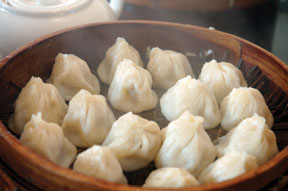
Located at 3420 S. Jones Blvd. just north of Spring Mountain, China MaMa is, like most of its kin, unassuming. Weathered façade notwithstanding, inside is a delicious treasure trove of both well-known and unusual dishes prepared in the tradition of two separate regions of China. You’ll know the difference from the menus: green for DongBei (Northeast) and red for Szechwan offerings. Yes, for a rookie it can be intimidating to navigate through vague descriptions; you may even be frightened by some of the more unusual dishes like Flambeed Chitins. Not to worry. Their friendly staff is happy to help, and those not feeling adventurous can stick to familiar options like their outstanding Kung Pao Chicken (9.95), coated modestly in a light sauce and tossed with peanuts, green onion and red peppers.
If you prefer to venture into new gastronomic territory, let China MaMa lead you down the road less traveled. Craving some of my all-time favorite staples from the East, we started off with China MaMa’s renowned Xiao Long Bao, or steamed juicy pork buns (7.95), and Green Onion Pancake (4.95). More like a dumpling than a bun, Xiao Long Bao is essentially a gingered pork meatball and a spoonful of garlicky broth contained in a thin pastry sheet and served with soy and chili garlic sauces for dipping along with fresh ginger strips. Green Onion Pancake was just as it should be–crisp and flakey on the outside, soft in the middle. Delicately fried without being greasy, it’s perfect all by itself, but dipped in soy or vinegar and chili sauce it’s immaculate.
You’d be remiss not to try the hand-pulled noodles, made in-house. Slightly softer than al dente, yet full of body, these supple noodles are served both in broth and dry. For a tepid foray outside the box, try them with Sesame Sauce (7.25), a creamy paste reminiscent of peanut butter, or as a chow mein with your choice of meat.
Crispy Chicken w/Szechwan Hot Sauce (12.50) is a novel alternative to orange chicken–tender white meat coated lightly in bread crumbs, deep fried and topped with a savory gravy, it’s subtle sweetness offset by a hint of tangy vinegar. Vegetable dishes abound, Spicy Stir Fried Eggplant (9.95) and String Beans w/Chef’s Special Sauce (9.95) topping the flavor charts. We all but inhaled the Cumin Spiced Lamb on Sizzling Plate (16.95). Unlike some cuts of lamb that can be fatty and difficult to chew, these thinly sliced bits were melt-in-your-mouth tender and seasoned to the extreme with zesty peppercorns, red chili and cumin. Beware! This dish is hot enough to make you sweat; cool the palate with a sweet and savory plate of Pineapple, Shrimp & Sausage Fried Rice (8.25)–delicately wok fried rice laden with chunks of juicy pineapple, small shrimp and sweet sausage akin to soft jerky–in a really great way.
Ending with a sweet Red Bean Pancake (4.50) for dessert, you’ll never look at take-out the same. China MaMa is open 7 days a week from 11 a.m.-10:30 p.m. For more information, call 873-1977.
The Planet and Your Pocketbook – Greening Up Your Home to Save Money
By Chad Felix
On the whole, the last decade saw a population concerned with saving the planet. Coming into the new year, we’re all rightly concerned about saving something else as well: money. Thankfully, there is a way we can do both, starting with an in-home energy assessment. Also known as a home energy audit, an energy assessment is a home walk-through in search of ways to improve energy efficiency. Once inefficiencies are identified, homeowners can form an effective plan for their solution.

The benefits of an energy audit are three-fold. First, saving energy means saving you money. Reducing your monthly electric bill is just the start; additional savings, via federal tax credits, are also available to homeowners who upgrade their homes with energy efficient products deemed eligible by government programs like Energy Star (www.energystar.gov). Second, an energy efficient home is a comfortable home. And finally, conserving energy means conserving our planet’s valuable resources. Just think of it as the sound foundation for your new year of dollar-saving, Earth-conscious good deeds.
Bright Idea for Savings
According to the U.S. Department of Energy, home illumination accounts for nearly 15% of your total bill. Studies show that if every American home replaced just one light with a light that’s earned the Energy Star, we would save enough energy to light 3 million homes for a year, save about $600 million in energy costs, and prevent 9 billion pounds of greenhouse gas emissions per year. Though more expensive at the checkout counter, Energy Star CFLs make up for it by saving energy, replacing incandescent bulbs of 3-4 times their wattage and lasting up to fifteen times longer. Just be sure to recycle; most CFLs contain traces of soil leaching mercury.
Smart Tip: Invest in a Smart Strip ($20-40), a device that shuts off power devices when not in use, thereby eliminating unnecessary idle current and potentially boosting power savings to about 73%.
The Heat is On
In a typical U.S. home, heating and cooling account for 56% of energy usage. As such, it’s crucial units are maintained and inspected at intervals suggested by the manufacturer. Generally, if your unit is more than fifteen years old, it is costing you and the environment too much to maintain. While the replacement of large home-appliances is never cheap, the money saved in energy costs offsets the expense over time. Replacing a 10-year-old unit with a newer model boasting a high Seasonal Energy Efficiency Ratio (SEER) rating can reduce your costs by 20-40%. Moreover, tax incentives and manufacturer rebates are often available to lessen the burden. Visit www.energysavers.com for incentives offered in Las Vegas.
Weather Stripping Woes
Other culprits of energy waste are air leaks. By blocking these drafts, homeowners can save between 5% and 30% on their energy bill. Check for leaks first by observing, then attempting to shake doors and windows. If you see daylight around a closed door, or upon shaking they rattle or shift, you may need to add or replace old weather stripping. If your windows and doors are old, consider updating or enhancing them with products that promote efficiency, such as storm doors, awnings, high-reflectivity films, shades, etc. Next, examine baseboards, electrical outlets, switch plates and attic hatches. For many of these, hardware stores provide ready-made products designed to eliminate the problem, but they can usually be fixed with caulk (or weather stripping for attic hatches). In the attic, heed air leaks around exposed pipes, ductwork, etc.
Tip: Simple and cheap, weather stripping is a sure bet and relatively easy to install. A simple search for “weather stripping” on www.familyhandyman.com offers guidance for proper installation.
Behind the Walls
Proper insulation and draft elimination go hand in hand, working together to resist the natural flow of warm air into cooler air, thereby reducing your heating and cooling costs substantially. As evaluating and installing your own insulation requires a bit more know-how than changing a light bulb, only those with prior experience should attempt it without professional help. However, it is good to understand that some forms of insulation are greener than others. Fiberglass insulation, for example, is made up of 40% recycled content; however, the process of creating it is an energy-intensive one. Cellulose insulation is 30 times more efficient to make than fiberglass and mineral wool, and comes largely from recycled newspapers. Similarly, cotton insulation is recyclable, plant-based, renewable and made largely of recycled materials. Consult with a professional to determine the greenest option suitable for your home.
So, with an increased, eco-conscious fervor, 2011 can be another grandiose step in the direction of big savings. Practical and easy enough for most homeowners, a home energy assessment is an excellent jumpstart for both saving money and committing year-round to helping out good old planet Earth.
Sidebar
If 2011 has brought you less time and more work, or maybe you just don’t have the know-how, professional companies are available to perform an energy assessment at your convenience. With specialized tools, equipment and knowledge, these companies can help maximize your savings and foolproof your efforts.
Service 1st Energy Solutions:
463-0244
Southwest Thermal Solutions:
www.southwestthermalsolutions.com
570-5932
Nevada Energy Audit:
448-2500
Be a Knockout … With Cardio Kickboxing
By DeDee Birdsall
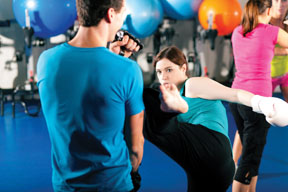
Looking to get fit in the new year and have fun while doing it? A high energy cardio kickboxing class might be the ticket to a leaner, stronger, more confident you. Inspired in the 90s by Frank Thiboutot and popularized by Billy Blanks’ Tae Bo explosion, it’s become a prominent fitness craze that can be found in gyms across the country, not to mention on DVDs for the at-home fitness junkie. A hybrid of boxing, martial arts and aerobics, this high-energy workout can burn anywhere from 350-500 plus calories in just under an hour, making it a great way to get you in knockout shape in no time.
Put Up Your Dukes
Most cardio kickboxing classes include a 5-10 minute warm-up of stretches and traditional exercises such as jumping jacks and push-ups; a kickboxing session of punches, kicks and knee strikes; total body conditioning work and a cool-down period. Upbeat music jams in the background to motivate participants and keep the class in sync while performing any combination of the following basic moves:
- Jab: A fast punch thrown straight ahead with a quick release.
- Cross: A punch thrown from one side of the body to the other.
- Hook: A round punch thrown from one side to the other in an arching movement with the elbow level to the arm.
- Upper Cut: An upward moving punch from the waist to chin height.
- Roundhouse Kick: The most powerful kick used in kickboxing, one foot is brought up to arch across the body by twisting at the waist.
- Side Kick: A kick performed out to the side of the body.
A good instructor will mix and match these basic moves to create challenging combos that work all parts of the body and keep the class interesting.
Total Body K.O.
When performed together, cardio kickboxing movements target nearly every muscle group in the body, firming it up from top to bottom and everywhere in between.
- Upper Body: Punches strengthen and tone the arms, back and chest muscles. Working in intervals and punch combinations, they also rev up your heart rate and improve hand-eye coordination, speed and agility.
- Core Work: Kicks, lunges and pivoting moves put the focus on core strength, which is essential to back health and balance. When performed correctly, these exercises also work those hard-to-tone lower abs, sculpt your legs, rear and back. Other core exercises included in all kickboxing classes are abdomen strengthening crunches, sometimes using weights for added benefits; twists that work the oblique muscles; and plank. Full planks and side planks are used to build a strong core, as well as endurance in the abs, back and stabilizer muscles.
- Lower Body: Lower body work in kickboxing is responsible for providing the most caloric burn during your session because it works the largest muscles in the body. In addition to powerful kicks, most kickboxing classes include squats, lunges, side steps and sprint intervals that tone the glutes, quads, hamstrings and calves.
Get Ready to Rumble
Aside from comfortable clothing and athletic shoes, a good set of boxing gloves is a must-have. Gloves not only help develop arm strength and protect the hands, they make you feel rough and tumble and in the groove. Everlast and Harbinger offer a variety of such gloves in different sizes, styles and weights to increase training intensity. Some can even be tossed into your washing machine (a great attribute since they soak up sweat just like shoes and socks).
Average glove prices run between $20 and $100, so do your research and talk to your instructor about what kind is right for you. If you’re not sure if kickboxing is your thing or plan to work out only a few times per week, start with a less expensive pair. Check out Sports Authority and Dick’s, as they let you try before you buy.
Hand wraps are worn under the boxing glove to cushion the impact of punches, protect your wrists and help prevent injuries to the hand. If you plan to do heavy bag work, they are a must; however, they aren’t necessary for shadow boxing only.
Tip: You may be tempted to purchase grappling gloves (a fingerless variety) as they do not appear as bulky as the standard glove and don’t require hand wraps, but some reports indicate these wear out quickly and are not as conducive to kickboxing.
Saved by the Bell
Every gym has something to offer all levels of fitness, so shop around until you find the class that best suits your skills, abilities and goals. Most gyms will allow you to try a session before you sign-up. Some popular Las Vegas gyms offering classes include Gold’s Gym, SuperFit, and Boe Boxing and Fitness. Inquire about the instructor’s credentials, as most major gyms require all instructors to maintain certifications.
Like all forms of exercise, you get out what you put into cardio kickboxing. It may be challenging at first–you’ll undoubtedly feel the burn after your first few classes–but don’t give up! If you go at your own pace and stop for water breaks when you need them, you’ll be jabbing, crossing and kicking your way to a better bod and loving every minute of it.
Kids in the Kitchen – Family-Friendly Cooking Activities
By Michelle Vessel
If echoing cries of “Mom, I’m hungry!” and “Mom, I’m bored!” are pretty much non-stop occurrences around your household, it may be time to introduce your kids to a hobby that can solve both of these problems in one fell swoop: the wonderful world of cooking. From barely-walking toddlers to teens on the verge of setting off on their own, there’s plenty of fun – and practical value – to be gained from spending time in the kitchen with your kids.

A Recipe for Success
According to Jennifer Low, author of Kitchen for Kids: 100 Amazing Recipes Your Children Can Really Make, cooking and baking call on a broad spectrum of skills and talents that will serve kids well throughout their entire lives. In addition to boosting their practical know-how and instilling a sense of how to find their way around a kitchen, cooking activities can help kids cultivate healthy eating habits and teach basic facts about nutrition. What’s more, registered dietician Susan Moores, a spokesperson for the American Dietetic Association, says that even the pickiest eaters are more likely to sample new foods if they had a hand in the meal preparation process.
Age-Appropriate Fun in the Kitchen
No matter what age group your child falls into, there’s bound to be something they can do in the kitchen. The trick lies in doling out age-appropriate tasks that are challenging and engaging without being overly complex or potentially dangerous.
Toddlers – For the littlest helpers, imitative kitchen play may be the best place to start. Set up their play kitchen while you make dinner, or give them a few safe pots, pans and utensils to play with. Once kids are old enough to follow simple instructions, have them rinse vegetables, carry discarded items to the trash can, stir foods that aren’t currently cooking and add sprinkles to baked goods.
Preschoolers (3-5) – Kids in this age group are often very enthusiastic kitchen helpers. Keep tasks relatively short and break up activities into distinct chunks, allowing them to assist by stirring foods, retrieving specific ingredients or (non-sharp) tools, adding pre-measured ingredients or tearing vegetables like spinach or lettuce. Older preschoolers with advanced motor skills may be ready to measure liquid or dry ingredients and crack eggs.
Primary grades (6-9) – This phase of childhood usually represents the height of pickiness and food selectivity, so give your child every opportunity to branch out by assembling and measuring ingredients, reading recipes, or stirring foods that are simmering over low heat in a sauté pan (under adult supervision, of course!). Pre-made components are a great way to encourage independent cooking skills, so stock up on things like pre-cooked pizza shells, frozen waffles, or steam-in-the-bag vegetables that can be used as a base for complete meals.
Tweens & Teens (10 & up) – Kids in this age group are usually ready to take on basic recipes with moderate supervision. Straightforward tasks like baking cookies from scratch, whipping up a batch of pancakes or French toast, or preparing a simple pasta dinner should be well within their abilities, especially with a bit of adult help and encouragement. As teens get older, many are ready to take on even the most challenging of cooking tasks. However, don’t assume too much; they may have difficulty winging certain skills without input from a knowledgeable adult. Within reason, feel free to give your teen free reign in the kitchen, reinforcing safety guidelines and setting clear expectations about after-meal cleanup. Begin introducing them to other aspects of food preparation, such as meal planning, budgeting and grocery shopping.
Take it to the Next Level
Now that you’ve introduced your kids to some basic cooking techniques, it’s time to branch out. Here are some project and activity ideas to entertain and educate the budding chef in your family.
Plant a kitchen garden – Take cooking a step further by growing your own ingredients. Opt for a large plot garden or stick with a few containers on your back porch, growing kid-friendly favorites like strawberries, watermelon, and pumpkin. Sneak in a few veggies for extra credit.
Cook up a science project – Measuring, mixing, blending – many of the basic techniques that you use when following your favorite recipe – can also be applied to science activities. Check the “recipes” listed on the website bizarrelabs.com for ideas and inspiration.
Plan a cuisine-themed party – If your pint-sized chef has some likeminded friends, consider hosting a cooking party. Assemble a make-your-own-pizza station, and then have the kids bake and decorate cupcakes for dessert. Spice things up with a Top Chef-style contest scaled back to match your child’s skill level.
Spend time with an expert – If your child shows a real flair for cooking, it may be worth it to invest in a cooking class. National chains like Whole Foods and Sur la Table often offer kids’ cooking classes; check with retailers in your neighborhood for specific details.
Cook by the book – Need some inspiration? Check out classic kids’ cookbooks from luminaries like Rachel Ray, Paula Deen, Emeril Lagasse, Martha Stewart and Williams-Sonoma.
Teaching your favorite foodies-in-training how to wield a spatula and crack an egg is just one part of spending time together in the kitchen. With a repertoire of basic techniques at their disposal and a little imagination, there’s no limit on the fun you can have with your kids in the kitchen, whether they’re toddlers, teens or somewhere in between.
This Space is the Place – Emergency Arts
By Chad Felix
Ours is an art scene that has habitually taken a back seat to bigger, louder parties. First Friday and a re-vitalized downtown arts district notwithstanding, the Vegas art scene is one more often entirely overlooked than actively participated in. Critics tend to cast it aside; casual patrons ignore it. But now that could be changing. Welcome Emergency Arts, the locally driven art space that turns the spotlight from marquee entertainers and drink specials to some of our biggest dreamers and heaviest thinkers.
Critical Conditions Inspire Big Ambitions
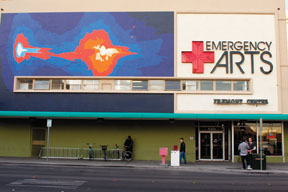
Without question, it is a bold, risky set of endeavors. First, convert an old hospital; Emergency Arts is located in the historic former Fremont Medical Building in downtown Las Vegas. Next, offer spaces to artists, photographers, actors, writers, graphic designers, retailers and more for as low as $200 a month. Finally, do what you can to help the community within those hospital walls survive with a little help from the community outside of them. Ambitious, yes, but it is succeeding, and all within the city of instant gratification. How? Because locals, as we know, want more than just stiff cocktails, loose slots and late nights. We are of a different breed, and this is something that Emergency Arts founders Michael Cornthwaite and Jennifer Harrington have taken into account.
Not Just Another Waiting Room
At the heart of Emergency Arts is The Beat Coffeehouse and Records. This full-menu toting, organic-coffee roasting café and record store is likely the best hospital lobby you’ve ever had the privilege to wait around in; certainly it is the only one in which you’ve browsed through records. With diverse menu offerings such as Greek yogurt and fresh croissants for breakfast; the Slap & Tickle (organic peanut butter, homemade jam and smoked bacon on a pan de mie) for lunch; and a wide selection of coffee, tea, beer and wine, a light meal at The Beat is the perfect start to your night downtown. Just add live jazz every Wednesday at eight or the Human Experience poetry readings every Monday at seven and you have an exciting new weekly outing. But this is just the lobby! After your meal, exploration is essential. Navigate the first and second story hallways of this tastefully restored hospital for a tapestry of artistic endeavors and innovative small businesses.
First Floor Discoveries
July 16th, 2010 marked the grand opening of Emergency Arts and the official opening of spaces on the first floor. Here patrons find both a variety of small businesses and gallery spaces. Bring your bicycle to the Bike Bucket–an independent co-op bike shop–for repair; find a unique new look at FlockFlockFlock Vintage Boutique or Haute Thrift’ture; discover what your blank walls have been missing at Sporadica Designs; or peruse the galleries of Jerry Misko, Mikel Patrik, Bryan Hainer Photography and The Burlesque Hall of Fame. Most importantly, discover some of the most creative minds this town has to offer.
The People Upstairs
Now, with 2011 upon us, Emergency Arts and its vibrant creative community is stepping it up once again with the grand opening of the second story. This floor boasts twenty new tenants with businesses ranging from yoga studios to vintage boutiques, small salons to large event spaces, health oriented nonprofits to mobile communication solution companies. Although fourteen of these spaces are already up and running, the official grand opening is due early in 2011. So join the Emergency Arts group on Facebook, follow them on Twitter or visit their website to be sure you don’t miss out on this big event!
Having a comfortable space of your own is one of the most valuable things for the aspiring artist and entrepreneur. Equally as important is feeling the support of your hometown and its people. With Emergency Arts, we’ve got the space. We’ve got the dreamers and the thinkers working in it. All we need now is for the community to stop by and enjoy it.
For information on upcoming events, specific business info and hours, space inquiries and general information, visit www.emergencyartslv.com.
Alex Forman
Faith Lutheran High School
Class of 2011
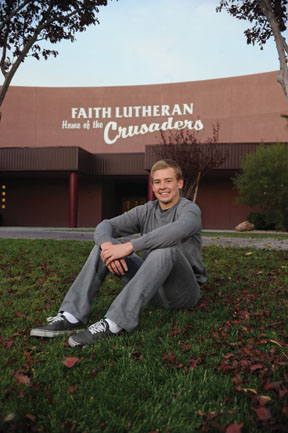
Undoubtedly, life comes fraught with highs and lows. The real challenge is to learn from our trials and forge positively into the future; a challenge that Faith Lutheran High School senior Alex Forman works to conquer every day. Realistic, grateful and humble, Alex sets up for the future by focusing on attainable goals and personal strengths, while being present for all of life’s day to day gifts. Soon he will most assuredly use his talents and intelligence to join the forces of the world’s forward thinkers, not simply for personal gain, but to be an inspiration and a leader, and for that, Alex Forman is – A Step Above.
G.P.A.: 3.9
Sports/Clubs:
- Varsity Lacrosse, 2008-Present
- Team Vegas Elite Lacrosse Team, 2009-Present
- Student Council, 2011
Awards/Community Service:
- Crusader Athletic Award, 2009
- Crusader Academics Award–3.75 G.P.A. and above for the entire year, 2009-10
- Sociology Student of the Year, 2009
- Donations to the Homeless, 2008-11
- Big Brother Lacrosse Program, 2011
Goals & Aspirations: “For now, I would like to graduate high school with scholar honors and a top 10 class ranking, and also get accepted to USC for the study of international business. One day I would like to have a positive impact on the development and overall distribution of vehicles fueled by alternative energy sources.”
Accomplishments Most Proud Of: “I am very proud of maintaining a 3.75 GPA (un-weighted) through all of high school; it took a lot of hard work and dedication. I am also proud of working full time every summer since 8th grade in order to save up for my car.”
Alex Looks Up To: “I look up to my father because he started his career without help from anyone. He worked his way from the bottom to the top of his business and became one of the most successful business owners I’ve ever met.”
Alex is Stronger and Wiser Because: “The loss of my mother when I was in the seventh grade was the largest obstacle in my life; but it has helped me to become closer to my family and become a much stronger person. The lesson learned from the experience is that every day is a gift, so don’t dwell in the past; be thankful for the present and look forward. Take risks and learn from your mistakes.”


